Introduction
Every hydraulic cylinder relies on the piston rod as its primary mechanical interface with the actuated mechanism. The piston rod must simultaneously transmit high mechanical loads, maintain precise linear positioning, resist wear at the cylinder seal interface, and withstand environmental exposure-all while operating in a reciprocating motion that subjects it to cyclic stress.
The consequences of a poorly specified or manufactured piston rod extend far beyond the rod itself. A failed or worn piston rod damages cylinder seals (requiring full cylinder overhaul), scores the cylinder barrel bore (potentially requiring barrel replacement), and causes unplanned equipment downtime that costs multiples of the rod's purchase price.
This guide covers the complete engineering and manufacturing process for hydraulic cylinder piston rods, from material selection through final inspection, providing engineers and procurement specialists with the technical reference needed to specify or manufacture quality piston rods.
Material Selection for Hydraulic Piston Rods
Carbon Steel Grades
45 Steel (CK45, AISI 1045) is the most widely used piston rod material for general industrial hydraulic cylinders. It offers an excellent balance of machinability, strength, and cost. After quenching and tempering heat treatment, 45 steel achieves:
Tensile strength: 600-750 MPa
Yield strength: 355-450 MPa
Elongation: 16-20%
Hardness: HRC22-28 (as heat treated)
45 steel is appropriate for:
Standard hydraulic cylinders with operating pressures up to 21MPa (3,000 PSI)
General industrial automation equipment
Agricultural machinery
Light to medium duty construction equipment
Limitations of 45 steel: Not suitable for operating environments below -20 degrees C, not recommended for high cycle fatigue applications exceeding 10 million cycles, and not appropriate for marine or high-corrosion environments without protective coatings.
Alloy Steel Grades
42CrMo (AISI 4140) is the preferred material for heavy-duty hydraulic cylinder piston rods. The addition of chromium and molybdenum improves hardenability, tensile strength, and fatigue resistance compared to carbon steel. After quenching and tempering:
Tensile strength: 750-900 MPa
Yield strength: 500-650 MPa
Elongation: 12-18%
Hardness: HRC28-35
42CrMo is appropriate for:
High pressure hydraulic systems (21-35MPa)
Heavy construction machinery (excavators, cranes, loaders)
Mining equipment
High cycle fatigue applications
38CrMoAlA is a nitriding-grade alloy steel specifically selected when the piston rod will receive gaseous or ionic nitriding surface treatment. The aluminum content (0.7-1.1%) specifically promotes the formation of hard aluminum nitride (AlN) precipitates during nitriding, producing a surface hardness of HV900-1100 without post-nitriding grinding.
38CrMoAlA is appropriate for:
Precision machine tool hydraulic cylinders
Hydraulic cylinders requiring exceptional wear resistance without chrome plating
Long stroke applications where weight savings from smaller rod diameter is valuable
Applications where chrome plating environmental concerns are a factor
Stainless Steel
304/316L stainless steel piston rods are specified for:
Marine and offshore hydraulic systems
Food and pharmaceutical processing equipment
Medical device hydraulic actuators
Chemical processing equipment
316L (low carbon) is preferred for welding applications and provides superior chloride corrosion resistance compared to 304. Mechanical properties of 316L after solution treatment:
Tensile strength: 480-680 MPa
Yield strength: 170-300 MPa
Hardness: HB150-200 (significantly lower than hardened carbon steel)
Critical note: Stainless steel piston rods have lower base hardness than carbon steel equivalents. For equivalent wear resistance, a harder surface treatment (hard chrome plating, nitriding, or plasma nitriding) is typically applied.
Heat Treatment Process
Quenching and Tempering
The standard heat treatment for carbon and alloy steel piston rods is quenching and tempering (Q&T). This two-stage process first austenitizes the steel at 830-870 degrees C, then rapidly quenches in water or oil to transform the austenite to hard martensite, followed by tempering at 550-680 degrees C to reduce brittleness while maintaining adequate hardness.
Purpose of Q&T for piston rods:
Achieves uniform base hardness throughout the cross-section
Improves toughness and impact resistance
Relieves internal stresses from prior machining operations
Provides consistent mechanical properties for fatigue resistance
Critical parameter: The tempering temperature must be selected to achieve the target hardness while avoiding the "temper embrittlement" range (250-400 degrees C) where notch toughness is significantly reduced.
Induction Hardening
For piston rods that will receive hard chrome plating, induction surface hardening is an alternative to through-hardening Q&T. This process heats only the surface layer to austenitizing temperature (850-950 degrees C) using high-frequency induction coils, then quench-hardens just the surface layer.
Advantages of induction hardening:
Core retains toughness (ductile) while surface achieves high hardness (HRC55-62)
Reduced distortion compared to through-hardening
Lower heat treatment cost and faster cycle time
Better fatigue resistance due to beneficial compressive residual stress at surface
Disadvantage: The hardened case depth is limited (typically 2-8mm), making it unsuitable for rods that will be heavily machined after heat treatment.
Manufacturing Sequence and Process Control
Standard Manufacturing Flow
Stage 1: Bar Preparation
Material verification (mill certificate review, chemistry confirmation)
Straightness check and straightening if needed (less than 1mm/m initial straightness)
Cut to length with appropriate machining allowance
Stage 2: Rough Machining
Rough turning to 0.5-1.0mm oversize on diameter
Drill or bore center holes for between-centers machining
Rough machine any keyways, grooves, or special profiles
Stage 3: Heat Treatment (Q&T)
Quenching and tempering to target hardness
Straightening if distortion exceeds tolerance (less than 0.5mm/m)
Stress relief if required before finish machining
Stage 4: Finish Machining
Finish turning to final diameter with 0.1-0.2mm grinding allowance
Thread rolling or cutting (depending on rod end connection type)
Final grinding sequence (see below)
Stage 5: Surface Treatment
Grinding to final diameter (achieve Ra target)
Hard chrome plating (if specified)
Final polish or micro-finish (if required for servo applications)
Grinding Sequence for Precision Piston Rods
Achieving the surface finish and dimensional accuracy required for hydraulic piston rods requires a multi-stage grinding sequence:
|
Stage |
Purpose |
Typical Material Removal |
Surface Roughness Achieved |
|
Rough grind |
Remove heat treatment scale and achieve near-net shape |
0.2-0.5mm per side |
Ra 1.6-3.2 micrometers |
|
Intermediate grind |
Approach final diameter, remove grinding stress |
0.05-0.15mm per side |
Ra 0.4-0.8 micrometers |
|
Finish grind |
Achieve final diameter and Ra target |
0.01-0.03mm per side |
Ra 0.1-0.4 micrometers |
|
Micro-finish |
Remove last few microns for servo applications |
0.002-0.005mm |
Ra 0.05-0.1 micrometers |
Coolant management during grinding is critical: inadequate coolant flow causes thermal damage (grinding burn) that manifests as re-tempered martensite in the surface layer, dramatically reducing fatigue life. Magnetic particle inspection after grinding is recommended to detect grinding burn.
Dimensional Tolerances and Inspection
Standard Tolerance Grades
|
Parameter |
Standard Tolerance |
Precision Tolerance |
|
Diameter tolerance |
IT6 (ISO 286) |
IT5 or better |
|
Surface roughness (Ra) |
0.4-0.8 micrometers |
0.1-0.2 micrometers |
|
Straightness |
0.03mm/m |
0.01mm/m |
|
Coaxiality (to seal area) |
0.02-0.05mm |
0.01mm or better |
|
Surface hardness |
HRC22-28 (45 steel) |
Per specification |
Inspection Procedures
Dimensional inspection: Continuous measurement during grinding using in-process gauging (laser, air gauge, or linear variable differential transformer). Final dimensional verification using micrometer and thread plug/rings.
Surface inspection: Surface roughness measurement using contact profilometer (per ISO 4288). Visual inspection under 10x magnification for chatter marks, burn marks, or spiral lead issues.
Hardness verification: Rockwell or Vickers hardness testing at multiple points across the cross-section to verify heat treatment uniformity.
Magnetic particle inspection (MPI): Performed after final grinding to detect surface cracks, grinding burn, or fatigue cracks that could cause premature failure.
Key Takeaways
45 steel (CK45) is the standard piston rod material for general industrial hydraulic cylinders (up to 21MPa); 42CrMo is preferred for heavy duty applications (21-35MPa); 38CrMoAlA is for nitriding-treated precision rods; 316L stainless for marine/food applications
Quenching and tempering heat treatment achieves 600-750MPa tensile strength in 45 steel and 750-900MPa in 42CrMo, providing the fatigue resistance required for cyclic hydraulic loading
The multi-stage grinding sequence (rough, intermediate, finish, micro-finish) is essential to achieve Ra 0.1-0.4 micrometers surface roughness and IT6 diameter tolerance; inadequate coolant causes grinding burn that reduces fatigue life
Surface hardness for chrome-plated rods is typically HRC22-28 base material with HV750-1100 chrome coating; without proper Q&T heat treatment, the base steel cannot support the chrome coating under load
Quality inspection should include in-process dimensional gauging, surface roughness measurement, hardness testing, and magnetic particle inspection to detect grinding burn or surface cracks
Conclusion
The
hydraulic cylinder piston rod is a technically demanding component that requires precise control of material, heat treatment, machining, and surface treatment to deliver reliable service life. The consequences of shortcutting any process stage-using the wrong material, skipping stress relief, inadequate grinding, or poor chrome plating quality-manifest as premature cylinder failure and costly equipment downtime.
For equipment manufacturers specifying hydraulic cylinders, understanding the material and manufacturing requirements for piston rods enables more informed supplier evaluation and more reliable product specifications. For end users, specifying the correct piston rod material and surface treatment for the operating environment is the single most effective way to extend hydraulic cylinder service life.
Wuxi Xinluo Hydraulic Machinery Co., Ltd. manufactures hydraulic cylinder piston rods with full in-house heat treatment, machining, grinding, and hard chrome plating capability, with ISO 9001 certified quality control throughout the manufacturing process.









 Home
News
Industry News
Hydraulic Cylinder Piston Rod: Material Selection, Manufacturing Process, And Performance Optimization
Home
News
Industry News
Hydraulic Cylinder Piston Rod: Material Selection, Manufacturing Process, And Performance Optimization 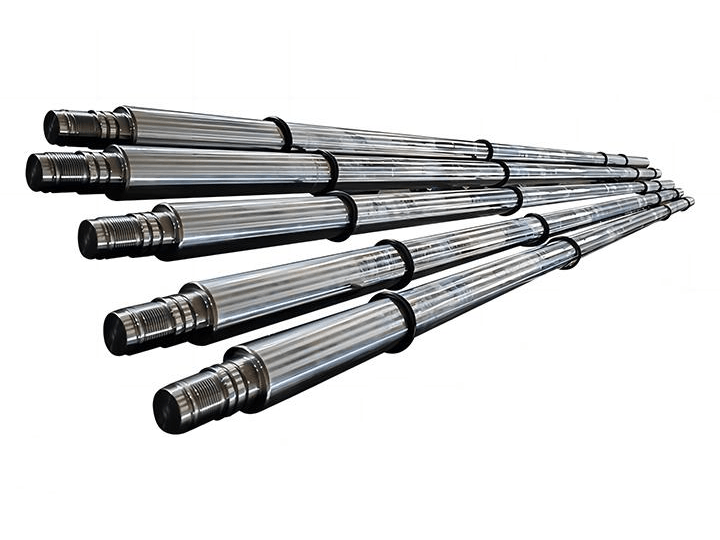

 +86 13771119215